



EU Food Import Requirements: 9 Essential Rules to Avoid Costly Rejections in 2026

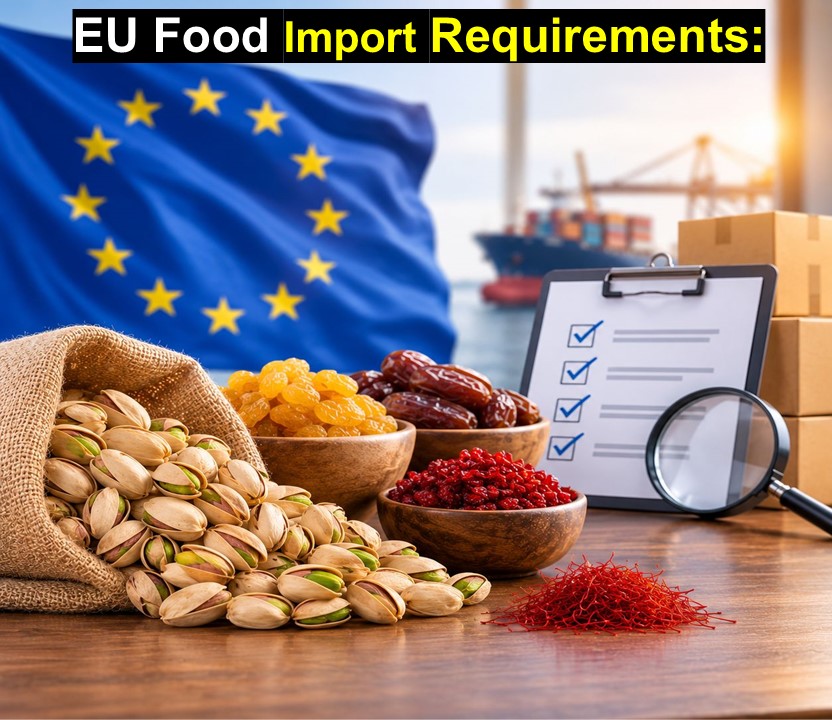
EU Food Import Requirements: 9 Essential Rules to Avoid Costly Rejections in 2026
Importing food into the European Union can open the door to one of the world’s largest consumer markets. However, entering this market requires more than finding a buyer, agreeing on a price and arranging transportation. Every food consignment must comply with the applicable EU food safety, hygiene, traceability and import regulations.
For international exporters and European food importers, understanding EU food import requirements before shipment is essential. Missing documents, excessive pesticide residues, aflatoxin contamination, incorrect labelling or inadequate traceability can result in additional inspections, delays, rejection or destruction of goods.
This guide explains the main requirements for importing food into the EU in 2026, with particular attention to plant-based products such as pistachios, dates, raisins, saffron, nuts, dried fruits and spices.
Table of Contents
- Understanding EU Food Import Requirements
- Food Safety and Hygiene Standards
- Pesticide Residue Limits (MRLs)
- Contaminants and Aflatoxin Regulations
- Official Certificates and Import Documents
- EU Border Controls and TRACES
- Food Labelling and Packaging Requirements
- Traceability and Supplier Verification
- How to Prepare a Food Shipment for the EU
- Frequently Asked Questions
- Understanding EU Food Import Requirements
The European Union applies strict food safety rules to imported products. Food originating outside the EU must meet the relevant safety standards applicable to food produced within the Union.
The main legal framework includes:
- Regulation (EC) No 178/2002: General food law, food safety principles and traceability.
- Regulation (EC) No 852/2004: Hygiene requirements for food businesses.
- Regulation (EU) 2017/625: Official controls on food and feed.
- Regulation (EC) No 396/2005: Maximum pesticide residue limits.
- Regulation (EU) 2023/915: Maximum levels for certain contaminants in food.
- Regulation (EU) No 1169/2011: Food information and labelling requirements.
These regulations do not mean that every food product needs the same certificates or border inspection. Requirements depend on the product category, country of origin, processing method, intended use and potential safety risks.
For example, importing dried dates, pistachio kernels, saffron or raisins generally follows a different control process from importing meat, dairy products or seafood.
Importers should therefore identify the exact product and its customs classification before arranging transportation.
- Food Safety and Hygiene Standards
Food hygiene is one of the most important EU food import requirements.
Under Regulation (EC) No 852/2004, food businesses must apply appropriate hygiene practices throughout the production and distribution process. Imported food must meet the relevant hygiene standards or equivalent requirements.
For exporters, this means that food safety should be controlled from the beginning of the supply chain, not only when the product reaches the port.
Important areas include:
Production and processing: Products should be handled under hygienic conditions. Processing equipment, production areas and storage facilities should be suitable for food handling.
Storage conditions: Food must be protected from moisture, pests, contamination and unsuitable temperatures. Products sensitive to heat or humidity require appropriate storage and transportation conditions.
Packaging hygiene: Packaging materials must be clean, suitable for food use and capable of protecting the product during transportation and storage.
HACCP-based procedures: Food businesses are generally required to establish and maintain procedures based on HACCP principles, together with good hygiene practices. The precise obligations depend on the operator’s activities and applicable exemptions.
For dried fruits and nuts, common risk areas include insect infestation, mould growth, moisture exposure, foreign materials and contamination during sorting or packing.
A supplier should be able to explain how these risks are controlled and provide relevant production and quality records.
- Pesticide Residue Limits (MRLs)
Pesticide residues are a major consideration when importing agricultural products into Europe.
The EU regulates pesticide residues through Regulation (EC) No 396/2005. This legislation establishes Maximum Residue Levels (MRLs) for pesticides in food and feed.
An MRL is the maximum legally permitted concentration of a particular pesticide residue in or on a food product.
The important point is that a product being legally produced in its country of origin does not automatically mean that it complies with EU pesticide limits.
EU rules apply to imported agricultural products as well.
For many pesticide and product combinations, the EU has specific MRLs. Where no specific MRL is established, a general default limit of 0.01 mg/kg commonly applies, subject to the legal provisions and exceptions.
Examples of products that may require pesticide residue assessment include:
- Raisins and other dried fruits
- Pistachios and other nuts
- Dates
- Saffron and other spices
- Dried figs
- Agricultural ingredients used in food manufacturing
Before shipment, exporters should identify the relevant pesticide limits for the exact product and arrange laboratory testing where appropriate.
A laboratory report should identify the tested product, sample information, analytical methods, results, units and relevant detection or quantification limits.
Important: A general statement such as “pesticide-free” is not a substitute for evidence of compliance with the applicable EU MRLs.
The European Commission provides information on “EU pesticide legislation and Maximum Residue Levels” (https://food.ec.europa.eu/plants/pesticides/maximum-residue-levels/eu-legislation-mrls_en).
- Contaminants and Aflatoxin Regulations
Contaminants are another critical issue for exporters of nuts, dried fruits and spices.
Depending on the product, EU legislation establishes maximum levels for contaminants such as:
- Aflatoxins
- Ochratoxin A
- Certain heavy metals
- Other regulated chemical contaminants
- Specific microbiological hazards under applicable legislation
Aflatoxins are particularly important for products such as pistachios, peanuts and certain other nuts.
They are toxic substances produced by certain moulds, especially under unsuitable agricultural and storage conditions. Contamination may occur before harvest or during drying and storage.
The EU regulates maximum contaminant levels through Regulation (EU) 2023/915, including its amendments. The applicable limit depends on the food category and, in some cases, whether the product is intended for direct consumption or further processing.
For pistachio exporters, aflatoxin testing should be considered an essential part of quality control.
A professional testing process should include:
- Representative sampling from the relevant batch.
- Testing by a competent laboratory.
- Identification of the tested product and batch.
- Reporting of aflatoxin results in the appropriate units.
- Comparison with the applicable EU legal limit.
One important mistake is relying on a laboratory report from a different production batch. A test result only provides evidence about the sample and batch it represents; it does not automatically guarantee that every future shipment will have the same result.
For products intended for the European market, buyers and suppliers should agree on the required testing method, sampling procedure and acceptable limits before finalising the purchase contract.
The official legislation is available through “Commission Regulation (EU) 2023/915”.
- Official Certificates and Import Documents
The required documents depend on the product and the applicable import procedure. There is no single certificate package that applies to every food shipment entering the EU.
For many commercial shipments of plant-based foods, the following documents may be required or requested by the importer:
Document| Purpose
Commercial Invoice| Shows the transaction value and seller and buyer details
Packing List| Identifies packages, quantities and weights
Bill of Lading / CMR / Air Waybill| Confirms transportation details
Certificate of Origin| Declares the product’s country of origin
Phytosanitary Certificate| Required for certain regulated plants and plant products
Health or Official Certificate| Required for specific products or special import measures
Laboratory Analysis| Provides evidence of compliance with relevant safety limits
Product Specification| Describes product characteristics and quality parameters
Not every document in this table is mandatory for every product.
For example, a phytosanitary certificate is required for certain plants and plant products under EU plant health legislation. It should not be assumed that every processed or dried food product automatically requires one.
Similarly, a certificate of analysis is an important commercial and quality-control document, but it does not replace an official certificate when EU legislation specifically requires one.
Before shipment, the importer and exporter should confirm the exact documents with the competent authority or customs broker in the destination country.
- EU Border Controls and TRACES
The European Union operates an official control system to check imported food and feed.
Depending on the product and its risk classification, border controls may include three main types of inspection:
Documentary checks: Authorities examine certificates and accompanying documents to verify that the shipment meets the applicable requirements.
Identity checks: Officials confirm that the actual goods correspond to the information declared in the documents, including product descriptions, labelling and transport details.
Physical checks: Authorities may inspect the goods, take samples and request laboratory testing.
The frequency of these checks depends on the product’s risk category and the applicable legal measures.
What is TRACES NT?
TRACES NT (Trade Control and Expert System) is an EU digital platform used to manage certain official controls and certification procedures for trade in animals, products of animal origin, plants and specific categories of food and feed.
For certain high-risk foods of non-animal origin, importers must submit a prior notification through TRACES NT and use the relevant Common Health Entry Document (CHED-D).
However, this requirement does not apply automatically to all dried fruits, nuts, spices or other plant-based foods.
The relevant products and countries are listed in Commission Implementing Regulation (EU) 2019/1793, which is updated periodically.
The regulation identifies specific combinations of product, country of origin and risk that may be subject to increased checks or special entry conditions.
For products listed in the relevant annexes, importers may need to arrange advance notification, official certification, laboratory analysis and border inspection.
The latest applicable rules should always be checked before shipment. In 2026, the EU also adopted further amendments to this framework, including Implementing Regulation (EU) 2026/1206.
Useful official resources:
- Food Labelling and Packaging Requirements
Food labelling is an essential part of the EU food import process, particularly for products sold directly to consumers.
Regulation (EU) No 1169/2011 establishes general rules for food information and labelling.
Depending on the product and its intended market, mandatory information can include:
- Name of the food.
- List of ingredients, where applicable.
- Allergen information.
- Net quantity.
- Date of minimum durability or use-by date, as applicable.
- Storage conditions.
- Name and address of the responsible food business operator.
- Country of origin or place of provenance where required.
- Instructions for use, where necessary.
- Nutrition declaration, subject to applicable exemptions.
For example, a retail package of pistachios may need clear allergen information because pistachios are tree nuts.
A package of date paste may require ingredient information, net quantity, storage conditions and other mandatory details depending on its formulation and presentation.
Language requirements
Mandatory food information must appear in a language easily understood by consumers in the Member State where the product is marketed. Member States may specify one or more official languages for this purpose.
A label prepared only in English may therefore be insufficient for some destination markets.
Food-contact packaging
Packaging that comes into contact with food must also comply with relevant EU food-contact material legislation.
Packaging should not transfer substances into food at levels that could endanger human health, cause unacceptable changes in the food or affect its taste and smell.
Exporters should confirm packaging specifications with their buyers, particularly for products intended for direct retail sale.
Official reference: “European Commission – Mandatory Food Information”
- Traceability and Supplier Verification
Traceability is a central principle of EU food law.
Under Regulation (EC) No 178/2002, food business operators must be able to identify the businesses from which they received food and the businesses to which they supplied it.
This is commonly described as the “one step back, one step forward” principle.
For exporters, maintaining reliable records helps buyers and authorities identify the origin and movement of a product if a food safety issue occurs.
A practical traceability system should include:
- Product and batch identification.
- Supplier and producer information.
- Production or packing dates.
- Relevant laboratory reports.
- Quantity and packaging records.
- Storage and transportation details.
- Commercial and shipping documentation.
For agricultural products sourced from several farms or processing facilities, batch separation and accurate records are especially important.
Mixing products from different suppliers without maintaining batch-level records can make it difficult to identify the source of contamination or investigate a complaint.
Buyers should also verify that suppliers have reliable quality-control procedures and can provide consistent documentation for each shipment.
- How to Prepare a Food Shipment for the EU
The best way to reduce import problems is to verify requirements before purchasing, packing or shipping the goods.
The following process provides a practical checklist for exporters and importers.
Step 1: Identify the exact product
Determine the commercial product name, processing method, intended use and relevant HS/CN code.
A dried product, a fresh product and a processed ingredient may be subject to different requirements.
Step 2: Confirm the country-specific requirements
Check whether the product from the specific country of origin is subject to additional restrictions, increased border controls or special certification.
Do not assume that the rules are identical for all countries.
Step 3: Review food safety limits
Check pesticide MRLs, contaminants, microbiological criteria and other requirements relevant to the product.
For nuts, pistachios and dried fruits, particular attention should be given to aflatoxins, other relevant mycotoxins and pesticide residues.
Step 4: Arrange laboratory testing
Where necessary, use a competent laboratory and agree with the buyer on the required testing scope.
Testing should relate to the actual shipment or clearly identified production batch.
Step 5: Confirm certificates and documents
Ask the importer or customs broker to confirm which official certificates, declarations and commercial documents are required.
If the product is subject to special border controls, arrange the required TRACES notification and supporting documents in advance.
Step 6: Approve packaging and labels
Review the retail or bulk packaging, food-contact materials, mandatory label information and destination-country language requirements.
Step 7: Confirm the import procedure before dispatch
Before the goods leave the exporting country, the importer should confirm the border entry point, applicable inspection procedure, customs classification and any required pre-notification.
This step is particularly important for products subject to increased official controls.
A shipment should not be dispatched based solely on the assumption that a buyer’s previous import experience covers the current product, origin and shipment conditions.
Frequently Asked Questions
- Can dried fruits and nuts be imported into the EU?
Yes. Dried fruits and nuts can be imported into the European Union if they comply with the applicable food safety, hygiene, contaminant, pesticide, traceability and import requirements.
Some products from certain countries may also be subject to additional border controls or special entry conditions.
- Is a health certificate mandatory for all food imports into Europe?
No. A health or official certificate is not universally required for every food product.
Requirements depend on the product category, country of origin and specific EU legislation. Certain high-risk foods of non-animal origin may require official certification, while other products follow different procedures.
- Does every food shipment require TRACES registration?
No. TRACES NT is used for specific categories of products and official control procedures.
Certain high-risk foods of non-animal origin listed under Regulation (EU) 2019/1793 require prior notification and a CHED-D. Many other plant-based food shipments do not follow this same procedure.
- What laboratory tests are important for pistachio imports?
Depending on the buyer’s requirements and the product’s risk profile, relevant tests may include aflatoxin analysis, pesticide residue testing, microbiological testing and other quality or contaminant analyses.
The applicable EU limits should be checked for the exact product category and intended use.
- Can food be rejected at an EU border?
Yes. A consignment may be refused entry if it fails to meet applicable food safety or import requirements, lacks required documentation or does not satisfy special entry conditions.
Depending on the circumstances, authorities may order further examination, treatment where legally permitted, re-dispatch or destruction.
- Who is responsible for meeting EU food import requirements?
The EU-based food business operator or importer has important legal responsibilities for ensuring that food placed on the EU market complies with applicable legislation.
Exporters also play a crucial role by supplying safe products, maintaining traceability and providing accurate documentation. Responsibilities should be clearly defined in the commercial agreement.
Conclusion: Prepare Before You Ship
Understanding EU food import requirements is essential for any business planning to export food products to Europe.
Compliance involves more than preparing a commercial invoice and arranging transportation. Exporters must pay attention to food safety, hygiene, pesticide residues, contaminants, traceability, packaging and the specific border procedures applicable to their products.
For importers, checking these requirements before placing an order can help prevent unexpected costs, shipment delays and rejected consignments.
For exporters of pistachios, dates, raisins, saffron, nuts and other agricultural products, a reliable quality-control system and accurate shipment documentation are important foundations for long-term business relationships in the European market.
Successful food exports begin with compliance before shipment—not after the goods reach the border.
HGHtrade international team is ready to supply you with dried nuts and fruits that meet the requirements of the European market.


