


Blog
The Ultimate Guide to International Shipping Terms: 11 great Rules Every Importer and Exporter Must Know
Meta Description
Discover the complete guide to Incoterms® 2020 for international import and export. Learn the differences between EXW, FOB, CIF, CFR, FCA, DDP, DAP, CIP, CPT, and more to choose the right shipping terms for your global business.
11 Powerful Incoterms Every Importer and Exporter Must Know | The Ultimate Guide to CIF, CFR, FOB, EXW & International Shipping Terms
International trade is built on trust, clarity, and well-defined responsibilities. Whether you are exporting premium Iranian pistachios, saffron, dates, or importing products from overseas, understanding Incoterms® 2020 is essential for reducing risks, avoiding costly misunderstandings, and ensuring successful global transactions.
Every international sales contract should clearly specify the agreed delivery term. Choosing the wrong Incoterm can result in unexpected transportation costs, insurance disputes, customs delays, or financial losses.
This comprehensive guide explains the most important Incoterms used in both international export and import, helping buyers and sellers make informed business decisions.
What Are Incoterms?
Incoterms stands for International Commercial Terms, a globally recognized set of trade rules published by the International Chamber of Commerce (ICC).
These rules define the responsibilities of buyers and sellers regarding:
- Delivery of goods
- Transportation costs
- Cargo insurance
- Export customs clearance
- Import customs clearance
- Transfer of risk
- Shipping documentation
Incoterms are used worldwide and apply equally to both exporters and importers, making them one of the most important foundations of international trade.
Why Are Incoterms Important?
Without clearly defined delivery terms, disputes between buyers and sellers become much more likely.
Using the correct Incoterm helps businesses:
- Minimize commercial risks
- Clarify responsibilities
- Reduce unexpected expenses
- Improve supply chain efficiency
- Prevent costly misunderstandings
- Facilitate customs procedures
- Strengthen international business relationships
For importers and exporters alike, mastering Incoterms is a competitive advantage.
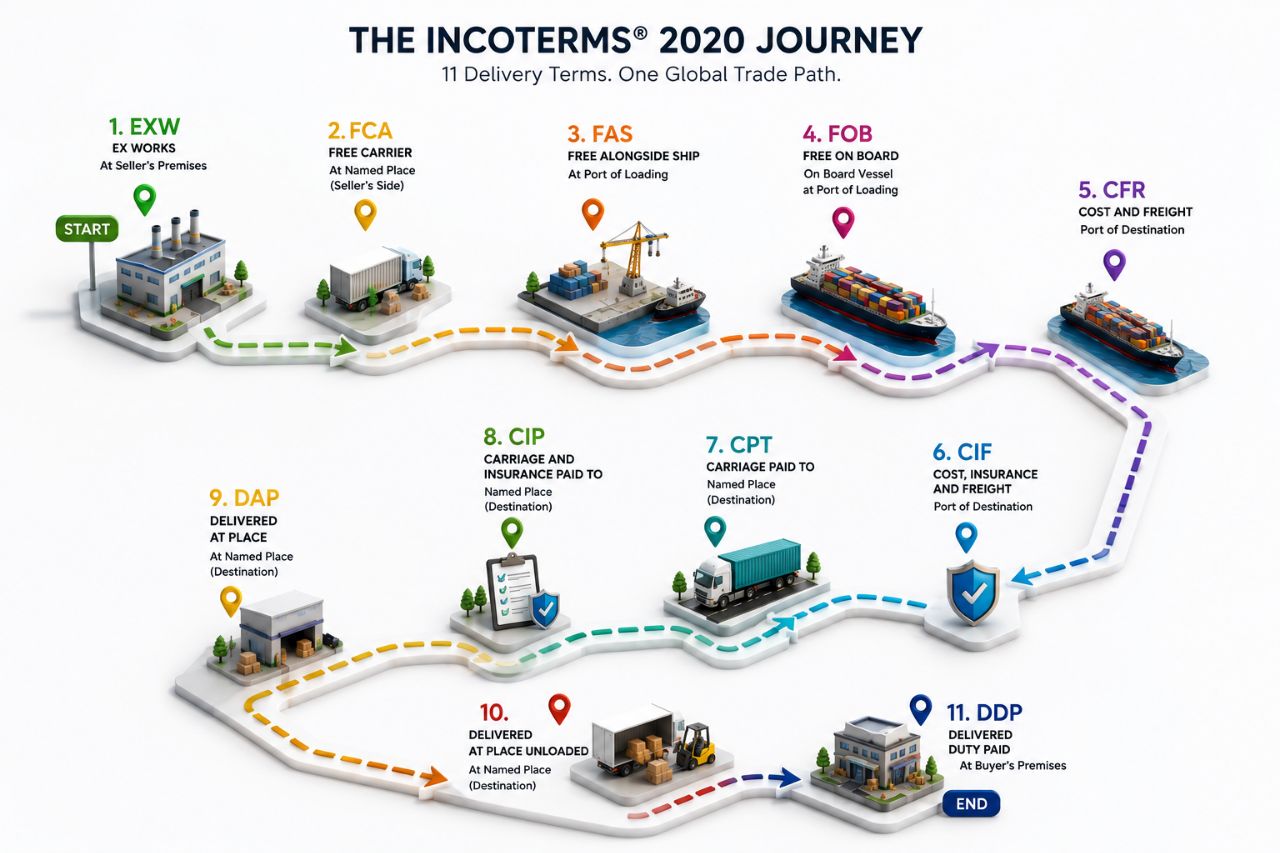
EXW (Ex Works)
Under EXW, the seller’s responsibility is minimal.
The seller simply makes the goods available at their factory, warehouse, or premises.
The buyer assumes responsibility for:
- Loading
- Inland transportation
- Export clearance
- International freight
- Insurance
- Import customs
- Final delivery
EXW offers maximum flexibility for experienced buyers who have established logistics networks.
FCA (Free Carrier)
FCA is one of the most commonly recommended Incoterms for international trade.
The seller delivers the goods to a carrier nominated by the buyer at an agreed location.
The seller is responsible for export customs clearance, while the buyer manages the remaining transportation.
FCA is suitable for road, rail, air, and sea transport.
FOB (Free On Board)
FOB is one of the best-known shipping terms for ocean freight.
The seller is responsible until the goods are loaded onto the vessel at the designated port.
Once the cargo is on board, all risks transfer to the buyer.
FOB is frequently used in the export of agricultural commodities, including pistachios, dried fruits, and food products.
CFR (Cost and Freight)
Under CFR, the seller pays the transportation cost to the destination port.
However, the transfer of risk occurs once the cargo is loaded onto the vessel at the port of shipment.
Although the seller pays the freight, the buyer bears the transportation risk during the voyage.
CFR is commonly used for bulk cargo and international sea shipments.
CIF (Cost, Insurance and Freight)
CIF is one of the most popular Incoterms in international trade.
The seller is responsible for:
- Export customs clearance
- Ocean freight
- Minimum cargo insurance
- Delivery to the destination port
Although the seller purchases insurance, the transfer of risk still occurs when the goods are loaded onto the vessel.
Many importers prefer CIF because it simplifies international purchasing and logistics management.
CPT (Carriage Paid To)
CPT requires the seller to pay transportation costs to the agreed destination.
However, the risk transfers to the buyer once the goods are handed over to the first carrier.
CPT can be used for all transport modes, including air, road, rail, and multimodal shipments.
CIP (Carriage and Insurance Paid To)
CIP is similar to CPT but provides an additional advantage.
The seller must arrange transportation and obtain cargo insurance with a higher level of coverage than CIF.
This Incoterm is particularly suitable for high-value products requiring additional protection during transit.
DAP (Delivered at Place)
Under DAP, the seller delivers the goods to the agreed destination, ready for unloading.
The buyer is responsible for:
- Import customs clearance
- Import duties and taxes
- Final unloading
DAP is widely used because it offers convenience while keeping import formalities under the buyer’s control.
DPU (Delivered at Place Unloaded)
DPU is unique because the seller is responsible for unloading the cargo at the agreed destination.
This delivery term is useful when the seller has greater control over unloading equipment or specialized logistics.
DDP (Delivered Duty Paid)
DDP represents the maximum responsibility for the seller.
The seller handles nearly every aspect of the shipment, including:
- Export clearance
- International transportation
- Insurance (if arranged)
- Import customs clearance
- Duties and taxes
- Delivery to the buyer’s premises
For buyers, DDP offers maximum convenience because almost the entire logistics process is managed by the seller.
Which Incoterm Is Best?
There is no single “best” Incoterm.
The ideal delivery term depends on factors such as:
- Buyer experience
- Seller capabilities
- Shipping method
- Customs procedures
- Insurance requirements
- Destination country
- Transportation costs
Experienced importers often prefer FCA or FOB, while buyers seeking simplicity frequently choose CIF or DAP. Companies wanting a complete door-to-door solution may opt for DDP.
Common Mistakes in International Shipping
Many businesses encounter unnecessary costs because they:
- Assume insurance is always included
- Misunderstand the transfer of risk
- Select inappropriate Incoterms
- Ignore import responsibilities
- Fail to define delivery locations precisely
Understanding Incoterms before signing a contract helps prevent these costly errors.
HGH – Your Reliable International Trade Partner
At HGH, we specialize in the international export of premium Iranian pistachios, pistachio kernels, dates, saffron, and other agricultural products.
We support global buyers with flexible shipping solutions under internationally recognized Incoterms, including EXW, FCA, FOB, CFR, CIF, DAP, and DDP, depending on customer requirements and destination markets.
Our experienced export team works closely with importers, wholesalers, distributors, and food manufacturers worldwide to ensure smooth logistics, transparent communication, reliable documentation, and efficient international delivery.
Whether you are importing premium Iranian products for Europe, the Middle East, Asia, or other global markets, HGH is committed to providing dependable export solutions tailored to your business needs.
Related Posts
6 Key Types of Shipping Containers in Global Logistics: The Ultimate Freight Shipping Guide for Dry, Reefer, and Specialized Containers
-
Posted by
 hassan ghalebsaz


